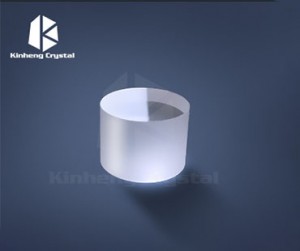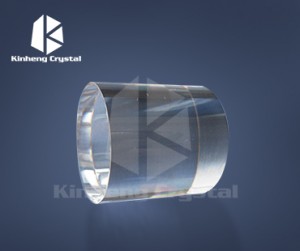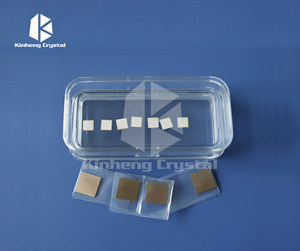

BaF2 Scintillator, BaF2 crystal, BaF2 scintillation crystal
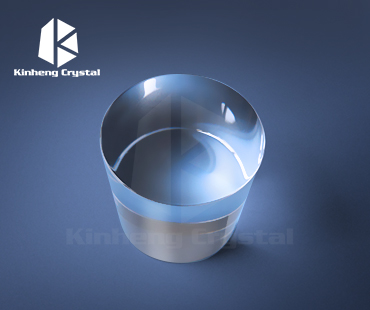
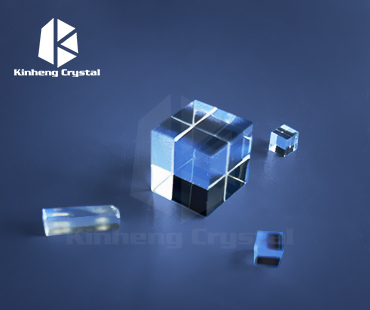


Advantage
● One of the fastest scintillators
● Produce optical emissions in the form of a ‘fast’ and ‘slow’ pulses
● Good scintillation and optical properties
● Good Rad-Hard properties
● Do not glow in UV
Application
● Positron Emission Tomography (PET)
● High energy physics
● Nuclear physics
● Nuclear medical instruments
● Optical UV-IR window
Properties
| Crystal System |
Cubic |
| Density (g/cm3) |
4.89 |
| Melting Point (℃) |
1280 |
| Atomic Number (Effective) |
52.2 |
| Transmission Range (μm) |
0.15~12.5 |
| Transmittance (%) |
>90% (0.35-9um) |
| Refractivity(2.58μm) |
1.4626 |
| Radiation Length(cm) |
2.06 |
| Emission Peak (nm) |
310(slow);220(fast) |
| Decay Time(ns) |
620(slow);0.6(fast) |
| Light Output (Comparing NaI(Tl)) |
20%(slow);4%(fast) |
| Cleavage Plane |
(111) |
Product Description
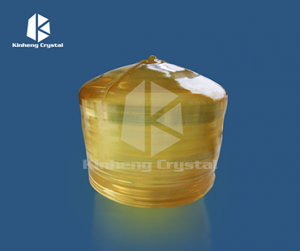
BaF2 stands for barium fluoride. It is a compound composed of barium and fluorine atoms. BaF2 is a crystalline solid with a cubic structure and is transparent to infrared radiation. Due to its good transmission properties over a wide wavelength range, it is often used as a material for lenses, windows and prisms in the field of optics. It is also used in scintillation detectors, thermoluminescent dosimeters, and other applications requiring radiation detection. BaF2 has a high melting point and is insoluble in water, making it a useful material in high temperature and corrosive environments.
Performance Testing
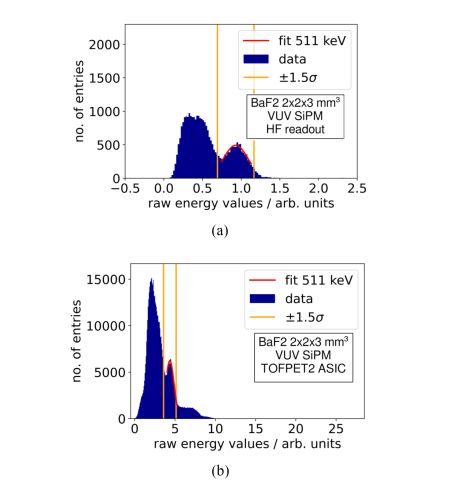
Energy spectra of the 2 × 2 × 3 mm3 BaF2 crystals measured on the (a) HF setup and (b) ASIC setup at a bias voltage of 60 V, with a threshold of 100-mV for the HF measurement and 6.6 mV for the ASIC setup. The HF spectrum is a coincidence spectrum, while the ASIC shows a spectrum of only one detector.